
 Upgrade Storage
Feature Request: Context-Aware Search with Relevance Ranking
Summary Zotero’s indexing engine is powerful, but the current search interface underutilizes it. Users often bypass Zotero’s internal search for external tools (Google Scholar, Mendeley, Semantic Scholar) because Zotero lacks context snippets and relevance-based ranking. This creates a significant friction point in managing large libraries.
Here are two specific improvements that would address these gaps:
1. Show Search Context (Snippets)
Current Behavior: Search results typically show only the title, author, and date. Users must open the document to see if the search term is actually relevant.
The Problem: This leads to "search leakage." As many of us experience, we end up searching Google Scholar or Mendeley just to see a snippet of the query within a paper we already own. We then download the file or re-verify it, only to realize we already have the item in Zotero.
Proposal:
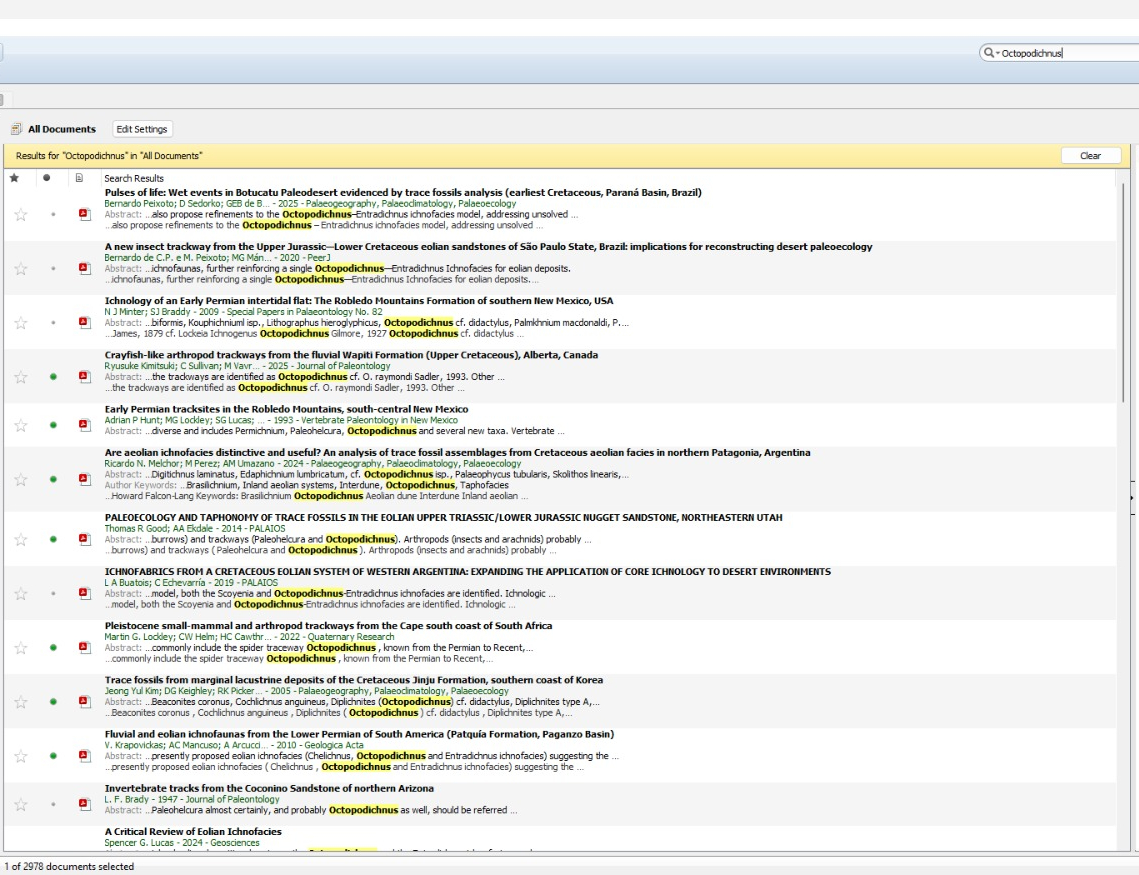
Display a text snippet (context) around the matched query term in the search results, similar to Mendeley and Google Scholar.
Advanced Option: Allow users to see context for every occurrence of the query in the document, not just the first instance. This would drastically reduce the need to open documents manually to verify relevance.
See how it works in Mendeley:
https://s3.amazonaws.com/zotero.org/images/forums/u21305599/1c7iadwp7ug0w4metlmf.jpg
2. Default to Relevance Ranking
Current Behavior: Search results are currently sorted by static columns (Date, Author, Title, etc.).
The Problem: The most relevant document (e.g., a match in the full text) might appear at the bottom of the list simply because it is an old paper or the author’s name falls toward the end of the alphabet. This makes finding the right paper difficult and unintuitive.
Proposal:
Implement a relevance-based ranking algorithm for search results.
Prioritize results based on how well the document matches the query intent (e.g., matches in the full text, frequency of occurrence, or proximity to the start of the document).
Keep the column sorting as an option, but make relevance the default.
Why This Matters:
This is a recurring complaint from my colleagues and the community. We started discussing this on the GitHub repository for a related add-on, but it highlights a core UX issue:
"If a user feels the need to leave the Zotero library to perform a meaningful search, the library’s search functionality is not doing its job."
Many colleagues still use Mendeley specifically because of its superior search context and ranking. We are not leaving Zotero because of its core organization features, but because the search experience feels "distrustful"—it doesn’t prove the results are relevant until we click into them.
Conclusion
Indexed information needs to be immediately useful. Zotero indexes everything in the document; exposing that data through context snippets and smart ranking would unlock the true value of the library.
Here are two specific improvements that would address these gaps:
1. Show Search Context (Snippets)
Current Behavior: Search results typically show only the title, author, and date. Users must open the document to see if the search term is actually relevant.
The Problem: This leads to "search leakage." As many of us experience, we end up searching Google Scholar or Mendeley just to see a snippet of the query within a paper we already own. We then download the file or re-verify it, only to realize we already have the item in Zotero.
Proposal:
Display a text snippet (context) around the matched query term in the search results, similar to Mendeley and Google Scholar.
Advanced Option: Allow users to see context for every occurrence of the query in the document, not just the first instance. This would drastically reduce the need to open documents manually to verify relevance.
See how it works in Mendeley:
https://s3.amazonaws.com/zotero.org/images/forums/u21305599/1c7iadwp7ug0w4metlmf.jpg
2. Default to Relevance Ranking
Current Behavior: Search results are currently sorted by static columns (Date, Author, Title, etc.).
The Problem: The most relevant document (e.g., a match in the full text) might appear at the bottom of the list simply because it is an old paper or the author’s name falls toward the end of the alphabet. This makes finding the right paper difficult and unintuitive.
Proposal:
Implement a relevance-based ranking algorithm for search results.
Prioritize results based on how well the document matches the query intent (e.g., matches in the full text, frequency of occurrence, or proximity to the start of the document).
Keep the column sorting as an option, but make relevance the default.
Why This Matters:
This is a recurring complaint from my colleagues and the community. We started discussing this on the GitHub repository for a related add-on, but it highlights a core UX issue:
"If a user feels the need to leave the Zotero library to perform a meaningful search, the library’s search functionality is not doing its job."
Many colleagues still use Mendeley specifically because of its superior search context and ranking. We are not leaving Zotero because of its core organization features, but because the search experience feels "distrustful"—it doesn’t prove the results are relevant until we click into them.
Conclusion
Indexed information needs to be immediately useful. Zotero indexes everything in the document; exposing that data through context snippets and smart ranking would unlock the true value of the library.